
Skip to safety guidance

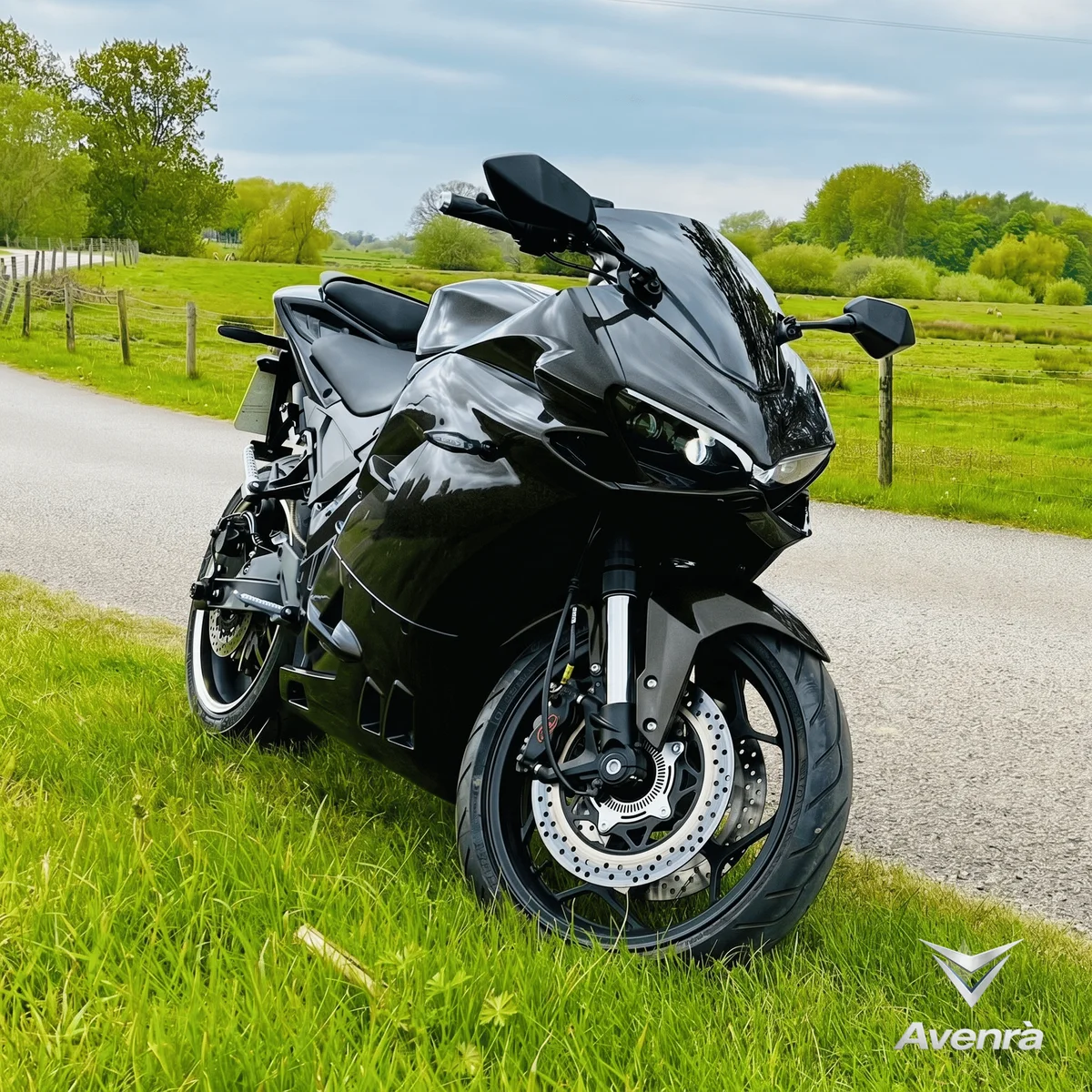
Avenrà EVO in Silverstone Black

OWNERSHIP / KNOW YOUR MOTORCYCLE

Electrical safety.
Responsible
maintenance.

Enjoy the ride. Understand the energy behind it.

Clear, practical guidance for Avenrà ONE and EVO owners, dealers and independent repairers. Know which checks belong in everyday ownership, and which jobs need specialist electrical competence.

Before you begin

AVENRÀ ONE + EVO Guidance for both models · EVO pictured.

FAMILIAR ON THE ROAD. DIFFERENT UNDERNEATH.

The licence category
doesn’t define the repair risk.

The Avenrà ONE and EVO both use high-energy electrical systems. Licence category, top speed and the selected power mode do not establish that an electrical repair is safe.

This guide applies to both the ONE and EVO, including the wiring and removal tasks described below. Routine care is still part of ownership. The key is recognising when a job moves from a visual check or mechanical task into the battery, charging or traction electrical system.

This is an awareness guide. Use the instructions for your exact motorcycle and task; this page is not an isolation procedure or a repair qualification.

01 / BEFORE YOU BEGIN

Match the work to the knowledge.

Think about what the job exposes, disconnects or changes—not just which panel comes off.

01OWNER CHECKS

Check. Clean. Observe.

Follow the owner’s manual for routine checks and care.

  • Tyre pressures, tread and visible damage.
  • Lights, mirrors and a visual check for damage or loose parts.
  • Cleaning using the methods specified in the manual.
  • Reading dashboard warnings and reporting changes.

If a check reveals a fault, stop and establish the right repair route.

02TASK-SPECIFIC SKILLS

Mechanical work.

Brakes, suspension and bodywork still require the correct skills, tools and service information.

  • Rear-wheel and tank/Type 2 assembly removal on both the ONE and EVO belong in the electrical-work category.
  • Panel removal must not damage or expose electrical connections.
  • Identify electrical precautions before starting the mechanical work.

A job’s mechanical purpose does not establish its electrical risk.

03ELECTRICAL SPECIALIST

The power system.

These jobs require relevant EV competence and the procedure for the exact vehicle.

  • Rear-wheel removal and tank/Type 2 assembly removal on the ONE and EVO.
  • Battery, HyperCore motor/controller and main power connections.
  • BMS, DC–DC converter, charging equipment and protection devices.
  • Work involving the battery-voltage ignition or instrument feed.

Contact Avenrà before opening, altering or attempting repairs to these systems.

Fairings off does not automatically mean danger. Intact covers and insulation reduce exposure. The risk changes when live parts become accessible, a tool can bridge connections, or wiring and protection are disturbed. Never assume that key-off means electrically isolated.

02 / AVENRÀ ONE & EVO

High voltage isn’t always
where you expect it.

Some apparently routine jobs cross directly into the traction electrical system. Identify the circuit before judging the task.

REAR WHEEL / TYRE WORK

Removing the rear wheel
is electrical work.

On both the ONE and EVO configurations covered here, the three motor-phase cables disconnect at the HyperCore controller, not at the wheel. The cable run passes back through the chassis to the left rear swingarm.

Wheel removal therefore involves disconnecting and handling traction-system wiring. A tyre job that requires the wheel off needs the specified HV isolation and verification procedure before those connections are disturbed.

A tyre workshop should confirm the electrical arrangements before accepting a wheel-removal job.

TANK ASSEMBLY / CHARGE INLET

The “tank” contains
charging connections.

The tank assembly houses the Type 2 charge connector. Removing that assembly requires disconnection of high-voltage wiring.

Treat removal as electrical work even if the purpose is cosmetic or access to another component. Unplugging the external charging lead does not, by itself, establish that all internal circuits are dead.

Battery-fed circuits and mains charging circuits need their applicable precautions.

A CONNECTION THAT IS EASY TO MISIDENTIFY

The ignition switch and instrument cluster have a battery-voltage feed.

A live feed from the nominal 72 V system runs to the ignition switch and instrument cluster. Do not assume that dashboard or ignition wiring is all 12 V, or that a small wire is a 5 V reference signal.

Wire size, connector appearance, component location and an unlit screen do not identify a safe voltage. The circuit must be identified from the correct information and its electrical condition verified before work.

Components and connections that require electrical awareness
Component or area What to understand before working
HyperCore motor & controller Part of the traction power system, including the three phase connections involved in rear-wheel removal.
Battery & BMS Connected to stored battery energy. A BMS command is not proof that every conductor or internal connection is dead.
72 V → 12 V DC–DC converter The unit that supplies 12 V equipment has a traction-battery input. Its 12 V output does not make the whole unit a 12 V component.
Charging control module Part of the 72 V system. Charging work must also account for any connected mains supply and stored charge.
Tank assembly & Type 2 inlet Removal requires high-voltage disconnection. A charging connector may contain circuits with different functions and voltages.
Ignition switch & instrument cluster A battery-voltage feed is present. Do not identify any individual wire as 12 V or a low-voltage signal by assumption.

ONE and EVO layout information confirmed by Avenrà HQ for this guide. Confirm the applicable configuration and procedure against the VIN and current service information. This overview does not identify terminals or provide a disconnection sequence.

03 / UNDERSTAND THE ENERGY

Three numbers. Different meanings.

EVO battery example: 72 V, 160 Ah and approximately 11.5 kWh. The capacity and energy figures are not ONE specifications. The safety principles apply to both models.

72V

Nominal voltage

The fully charged voltage is higher. Use the maximum voltage stated on the pack label and in its service information.

160Ah

Battery capacity

A measure of stored charge. It does not mean current is limited to 160 amps.

11.5kWh

Approximate stored energy

Calculated from 72 V × 160 Ah. Switching the motorcycle off does not remove this energy.

Electric shock

Contact with live conductors can cause injury. Voltage, moisture, skin condition, the current’s route through the body and contact duration affect the outcome. A lower voltage does not establish that touching conductors is safe.

Short circuits & burns

A metal tool or jewellery bridging live connections can heat rapidly and cause arcing or molten-metal injuries. You can suffer serious burns without current passing through your body.

Battery damage & fire

Physical damage, incorrect charging or an electrical fault can cause uncontrolled heating inside lithium-ion cells. In some circumstances this can spread, producing fire and hazardous gases. A problem may emerge after the work is finished.

Background: HSE electrical injuries · HSE battery hazards · London Fire Brigade battery safety

ONE PRINCIPLE TO REMEMBER

Switched off is not
the same as proved safe.

A dark dashboard, an app’s “off” status or a BMS command does not prove that the parts being worked on are dead. On both the ONE and EVO, a battery-voltage feed reaches the ignition and instruments. Battery internals remain energised, and some components can retain charge after disconnection.

Electrical work needs the manufacturer’s isolation and verification procedure, carried out by someone competent for that task. Never improvise a procedure from another bike or an online video.

04 / GUIDANCE FOR YOUR ROLE

A shared standard of care.

Competence is specific to the task. A dealer badge or experience with petrol motorcycles does not, on its own, establish electrical competence.

FOR OWNERS

Look after your bike.
Know when to ask.

Follow the owner’s manual and report faults early. Keep a record of warning messages, when they appeared and any recent damage or changes.

Before fitting accessories or removing panels, check whether the job involves traction wiring, charging equipment or protected components. If that is unclear, ask HQ or your dealer before starting.

Ask about a planned job

FOR DEALERS

Explain the boundaries.
Assign the right person.

Share this guide during handover and when arranging servicing. Establish whether your workshop and the assigned technician can safely perform the specific task.

If the job exceeds your capability, coordinate with Avenrà before dismantling. Record the fault, vehicle identity and any modifications, and manage access to a damaged vehicle.

Open the dealer portal

FOR INDEPENDENT REPAIRERS

Start with the vehicle.
Then define the job.

Independent repairers should establish the exact model, battery and electrical configuration, obtain relevant service information and confirm competence, equipment and workplace arrangements.

Contact HQ for the applicable information and support route before electrical work. After repair, use the specified checks and document what was changed before returning the bike to service.

Request technical guidance

05 / SOFTWARE, TUNING & MODIFICATIONS

Access to a setting
isn’t proof it is safe.

Third-party tuners and tools may make additional HyperCore controller settings accessible over time. Being able to unlock more power does not establish that the resulting configuration is safe for the motorcycle.

This applies to both the Avenrà ONE and EVO, whether a change is made through software alone or alongside replacement hardware.

Check a proposed change

Software changes have physical effects

Changing current limits or power delivery can increase loading and heat in the battery, cables, connectors, controller and motor. Other settings can change acceleration, regenerative braking or the way protection functions operate.

A successful test is not validation

A bike starting, riding normally, completing a dyno run or showing no warnings does not prove a configuration is safe across temperatures, states of charge and sustained use. A functioning BMS does not validate a controller remap.

Approval must match the actual bike

Obtain written confirmation from Avenrà that the exact software, settings and hardware combination is approved for your model and configuration. Approval of an original component does not extend automatically to a modified setup.

AVENRÀ ONE & EVO / UNAPPROVED CHANGES

No unapproved software update or manipulation can be presumed safe.

This includes firmware updates, remaps, configuration changes and manipulation of the HyperCore controller or associated vehicle systems. The same principle applies to changes made by an owner, dealer, independent repairer or third-party tuner.

Do not install or use software or settings that Avenrà has not approved for the exact vehicle configuration. If an unapproved change has already been made, stop using the motorcycle and contact Avenrà HQ before further use. Explain what was changed; do not assume that loading another settings file or restoring an apparent default proves the bike is safe.

Protection devices

Do not bypass the BMS, bridge a fuse or defeat a safety interlock. A protection trip needs diagnosis, not a workaround.

Charging & accessories

Use equipment and connection methods specified for your bike. Connector fit does not establish compatibility. Do not tap accessories directly into the traction battery or assume ignition wiring is 12 V.

The complete configuration

Hardware and software changes need assessment together. Discuss the relevant service requirements and any effects on the motorcycle’s specification, warranty terms and insurance before proceeding.

Background on increased electrical loading: Department for Transport guidance on modification and de-restriction. That guidance concerns e-scooters; the electrical-loading principle informs this motorcycle guidance. Avenrà’s approval statement above applies to the ONE and EVO.

06 / WHEN SOMETHING IS WRONG

Recognise the signs.
Take the right next step.

Damage or a warning needs attention. Heat, gas or smoke can require immediate action.

STOP USING & SEEK ADVICE

Damage or an unexplained fault

Examples include damaged cables or connectors, a charging fault, repeated protection trips, or suspected battery damage after an impact or water ingress.

Stop riding and charging. Contact Avenrà or the dealer for advice before restarting, dismantling or arranging transport. Do not open the pack to investigate.

MOVE AWAY & PROTECT PEOPLE

Abnormal heat, hissing, gas or smoke

Swelling, unusual chemical smells and hissing or cracking can indicate battery failure. Do not touch, move or open a battery showing these signs.

If it is smoking, venting gas, rapidly heating or burning, move away, alert others and call 999 from a safe place. If indoors, leave the building. Do not delay evacuation to disconnect charging or try to tackle the fire.

Tell the operator that a lithium-ion motorcycle battery is involved. Avoid fumes and stay out.

Read the London Fire Brigade’s lithium-ion battery warning signs. Its advice explains the general battery hazard; this page applies that principle to motorcycle ownership.

07 / STRAIGHT ANSWERS

Questions worth asking.

Facts that help you make a sensible decision before starting work.

Is 72 V really high voltage?

In electric-vehicle terminology, DC systems above 60 V are classed as high voltage. Definitions differ in other industries. On both the ONE and EVO, nominal voltage is not maximum charged voltage, and neither number should be treated as permission to touch live parts.

The risk is lower than a much higher-voltage pack under equivalent contact conditions, but shock, short-circuit burns and stored energy still require proper precautions.

Does a 5C discharge rating make a difference?

Using the EVO’s 160 Ah pack as an example, 5C corresponds to 800 A. This is not a discharge-current specification for the ONE. Whether that is continuous or a brief pulse depends on the manufacturer’s specification and conditions. It is not a guarantee that fault current stops at 800 A.

High current capability matters when a metal object creates a short circuit. It does not mean the pack forces 800 A through a person: body current depends on voltage and the contact path. Do not use a C-rating to decide whether a repair is safe.

Will the fuse or BMS protect me?

They provide important system protection, but they are not a substitute for safe isolation. A harmful current through a person can be far below a main fuse’s operating current. A fault may also occur at a point outside the protection path, including inside the pack.

Never assume a BMS “off” indication makes every connection safe to touch.

Can I remove a fairing or fit an accessory?

Removing a cosmetic panel is not the same task as opening a battery. Follow the instructions for your exact bike and avoid disturbing electrical covers, cables or connectors. On both the ONE and EVO, the tank/Type 2 assembly is not simply a cosmetic panel: its removal requires HV disconnection.

If the job exposes power connections, requires electrical disconnection or has no applicable instructions, stop and ask for guidance. Accessories must use the specified connection method. Do not tap the ignition or instrument wiring on the assumption that it is 12 V.

Why does removing the rear wheel need HV isolation?

On both the ONE and EVO, the three motor-phase leads disconnect at the HyperCore controller. There is no wheel-end disconnection on the configurations covered here, so wheel removal involves the traction wiring and its route through the chassis to the left rear swingarm.

The workshop must have the capability and model-specific procedure to safely isolate, verify, disconnect, reinstall and check that system. The fact that the intended job is a tyre change does not remove the electrical part of the work.

Is an almost-empty battery safe to work on?

No. A low state of charge still leaves voltage and energy in the pack. The dashboard reaching 0% does not mean the cells are electrically dead. Disconnecting the pack from the bike also does not make its internal connections dead.

Can my usual motorcycle workshop work on it?

That depends on the job and the workshop’s actual capability. Mechanical work needs the appropriate skills and any electrical precautions required by that task. Work on the traction system requires relevant EV competence, equipment and model-specific service information.

An independent workshop can contact Avenrà to establish the right information and support route. Reading this page or completing a general awareness course does not, on its own, qualify someone to carry out electrical repairs.

Can a tuner safely unlock more power in the HyperCore controller?

Access to additional power or settings does not establish safety. On both the ONE and EVO, unapproved firmware, software updates, remaps or configuration manipulation cannot be presumed safe—even if no hardware is changed and the motorcycle appears to work normally.

Only use a software and hardware combination approved by Avenrà for the exact vehicle configuration. A short test, a tuner’s assurance or the absence of fault codes is not a substitute for that approval. Contact HQ before making changes, or before further use if an unapproved change has already been made.

What should I send when I contact Avenrà?

Your model, registration or VIN, the symptoms or warning messages, when they began, and details of recent work, impact, water exposure or modifications, including controller software and settings changes. Describe the work you intend to do and whether you are the owner or repairer.

Include photographs only when they can be taken safely without dismantling or approaching a failing battery. If there is smoke, gas or rapid heating, follow the emergency guidance first.

AVENRÀ HQ / TECHNICAL GUIDANCE

Before you undo it,
ask us about it.

A short conversation can identify the right information, the right repair route and the right person for the job.

For routine enquiries only. An active battery emergency needs the emergency services.

Further reading HSE: electric and hybrid vehicle repair · HSE: electrical injuries · HSE: storage battery hazards · London Fire Brigade: battery fire response · Understanding C-rates

Published 25 September 2026 · Guidance version 1.2 · Applies to the Avenrà ONE and EVO. EVO battery figures are illustrative and are not ONE specifications; equipment and specifications can vary by vehicle. Follow the applicable owner’s manual, pack label and current service information. This guide does not establish a vehicle’s electrical condition or replace task-specific instructions.

Avenrà Live

System Ready

Welcome to Avenrà Live.

To route you to the correct specialist, please enter your first name below.