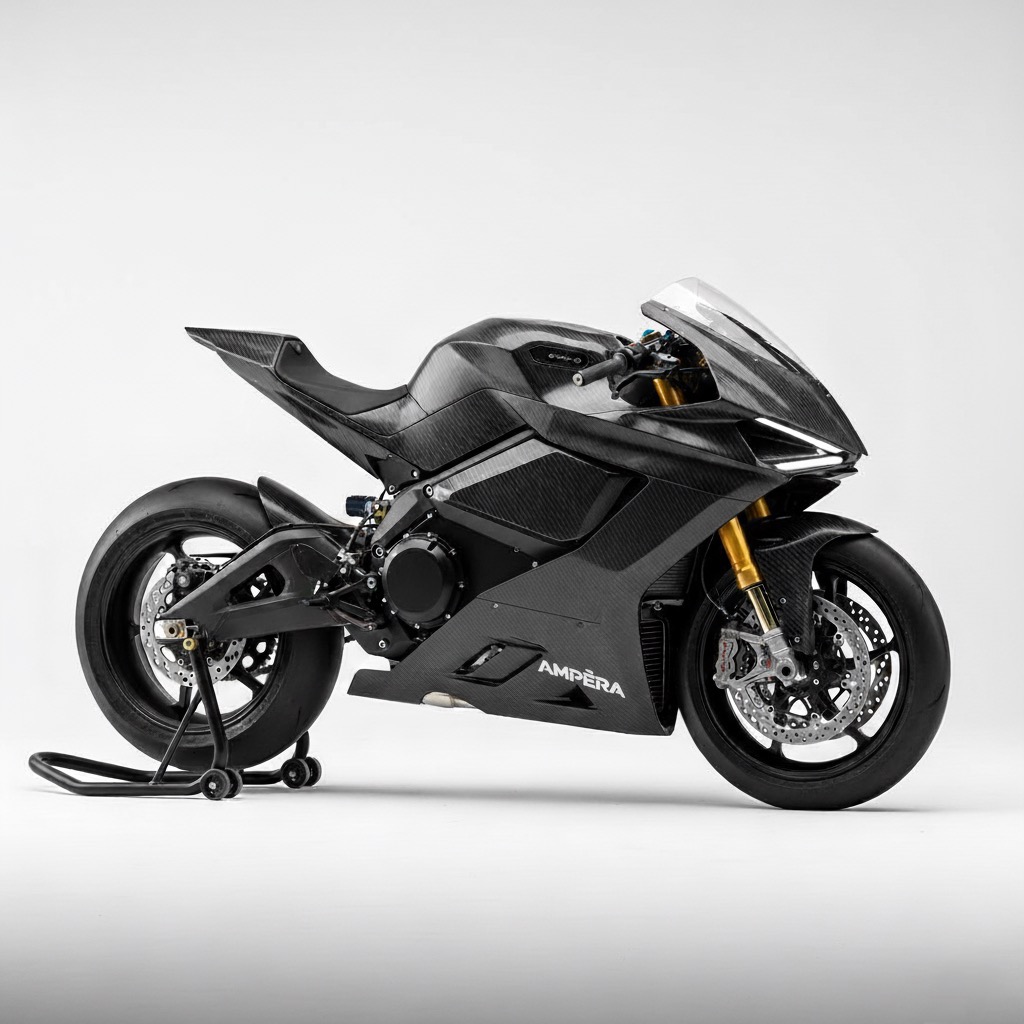
The Smartest Man
In The Room
// Subject: Jay Dong, Head of R&D
"Driving through Lingang, any prejudice you have about 'Made in China' evaporates. This isn't cheap manufacturing; this is the Silicon Valley of hardware. To my left, a BYD battery lab. To my right, Tesla. And in the middle, Ampèra's Advanced R&D Centre."
I had done my homework on Jay Dong. I wish I hadn't. Reading his CV before an interview is like reading the safety briefing before a cage dive with a shark. It doesn't make you feel safer; it just lets you know exactly how outmatched you are.
His career is a map of the electric revolution. NIO in Shanghai, leading the 'thermal strategy' for 200kW supercars. Then UAES—the Bosch joint venture—learning the brutal, non-negotiable safety standards of German automotive engineering. And an MSc from SJTU, the 'MIT of China'.
We meet in his office. It is a glass box suspended above the R&D floor. To my left, a sterile 'Cleanroom' hums with activity. Technicians in white anti-static coats move with practiced efficiency, assembling battery modules with robotic precision. It makes a hospital operating theatre look like a teenager's bedroom.
Jay is perfectly still. He speaks quietly, with the precise, polite diction of a man who is constantly translating complex physics into sentences a toddler—or a journalist—might understand.
"The EVO is a kinetic tool," Jay explains, his fingers steepled. "But Project A:EX is a physics demonstration. We are not solving for 'speed'. We are solving for 'thermal variance'. Speed is just the byproduct."
I nod, trying to keep up. "Right. So, the battery... it's Graphene?"
"Graphene-enhanced solid-state, yes," Jay corrects gently. He sounds like a disappointed teacher. "Standard Lithium-Ion has high impedance. Impedance creates heat. Heat creates throttling. By using a solid electrolyte and graphene structure, we reduce internal resistance to almost zero."
/// TRANSLATOR'S NOTE
In plain English: Batteries get hot when you use them hard. When they get hot, the bike slows down to protect them. Jay's new tech doesn't get hot. That means you can do 0-60 in 1.9 seconds, over and over again, until you pass out. It effectively kills the concept of 'overheating'.
"We run an 800-volt architecture," Jay continues, pointing to a schematic on his screen. "This allows us to push 180 kilowatts of peak power without the cabling becoming... substantial."
"180 kilowatts," I calculate mentally. "That's nearly 240 horsepower. In a bike that weighs less than a 600cc?"
"Correct. But power is irrelevant without thermal management. We use a direct oil-immersion cooling system. The stator is bathed in dielectric fluid." He pauses, checking if I'm following. I smile weakly.
"So," I ask, feeling brave. "The documents say the top speed is governed to 200mph. Why limit it?"
For the first time, Jay smiles. It is a small, knowing smile. "Two reasons," he states, holding up two fingers.
"First, tyre hysteresis," he says, as if discussing the weather. "At sustained velocities above 210mph, the rear compound generates heat faster than it can shed it. Structural delamination becomes a statistical probability. We prefer our riders to remain... intact."
"And the second?" I ask.
"Regulatory foresight," Jay replies, tapping the desk. "We are aligning with future UNECE type-approval frameworks for the European market. It is strategic compliance. We do not wish to build a vehicle that becomes illegal in 2028."
I hesitate, then ask the question everyone wants to know. "But Jay... if I wanted to buy one? If you put this on the market today. How much?"
Jay looks at me with mild amusement, as if I've asked how much a sunset costs.
"Commercial viability is not my department," he says, waving a hand at the cleanroom below. "However..."
He glances at a monitor showing the bill of materials. "The carbon-aramid monocoque tooling alone is significant. The graphene cells are... bespoke." He does a quick mental calculation.
"If we built ten units? £85,000," he says flatly. "If we built one? You couldn't afford it."
He turns back to his screen. The interview is over. I leave the office exhausted, trying to appear smart, but mostly just grateful that this man is building our bikes and not, say, a doomsday device.